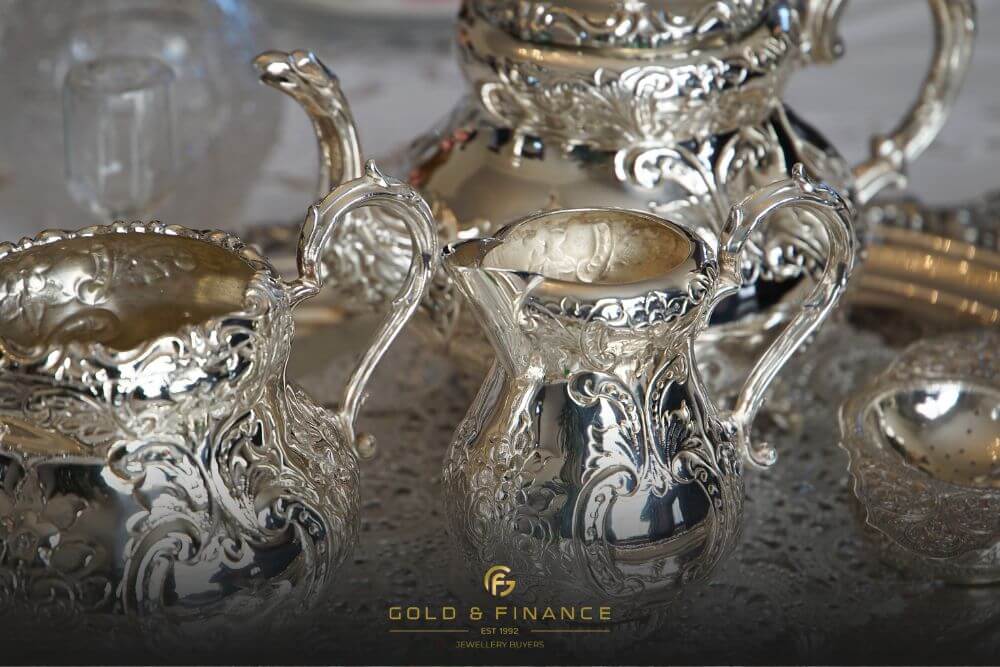
That sterling silver tea set in the display cabinet. The candlesticks at the back of the linen cupboard. The tray you inherited but never use. For many South African families, silverware has been quietly sitting in drawers and cupboards for decades, polished occasionally, admired sometimes, but rarely put to practical use.
If you’ve found yourself wondering whether it might be time to let it go, you’re not alone. And the short answer is: it depends, but for many people, selling makes a great deal of sense.
The Case for Selling
Silverware was once a staple of the well-appointed home. Before stainless steel became the everyday standard, sterling silver tea sets, serving trays, candlesticks, jugs, and bowls were found in households across the country. Today, formal entertaining has largely given way to more casual living, and much of this beautiful silver simply sits unused.
There is no sentiment in letting something of real value gather dust. Sterling silver carries genuine worth, not just as a precious metal, but sometimes as a collectable piece with history behind it. The question is not whether your silverware has value. The question is whether that value is working for you.
Understanding What You Have
Before making any decision, it helps to know what you are working with. Not all silverware is equal. The key distinction is between sterling silver and silver-plated items.
Sterling silver is stamped “925” or “Sterling”, indicating 92.5% pure silver content and the hallmark of genuine precious metal. Silver-plated items, by contrast, carry only a thin layer of silver over a base metal and are valued quite differently.
Beyond the silver stamp, each piece carries a hallmark unique to its manufacturer. If a piece is more than 50 years old, it may qualify as an antique, which can carry additional interest depending on its age, maker, and condition, though silver content and weight remain the primary basis for most valuations.
How to Identify Your Silverware
- Look for hallmarks. If marked ‘925’ or ‘Sterling’, it is sterling silver.
- Use an online hallmark guide (such as 925-1000.com) to identify the maker.
- Match the pattern to the manufacturer’s range. If the piece is over 50 years old, it may qualify as antique.
Common Reasons People Choose to Sell
The circumstances vary widely. Some sellers have inherited silverware through an estate and simply have no personal attachment to the pieces. Others are downsizing, moving into a smaller home or clearing out a family property, and want to convert idle assets into something more useful. Others are navigating a period of financial pressure and want to unlock the value sitting in items they no longer need.
Whatever the reason, selling silverware is a practical, legitimate choice. You do not need original boxes or proof of purchase. You do not need to have all the pieces in a set. You simply need to know where to take them for a fair, professional assessment.
Who Should You Trust?
Silver buyers vary considerably in their expertise and transparency. Choosing a reputable buyer, one with a track record, professional accreditations, and a clear valuation process, makes a meaningful difference to the outcome.
Gold & Finance was established in 1992 and has been South Africa’s trusted precious metals buyer since. With over three decades of experience and accreditation from the Jewellery Council of South Africa (JCSA) and the Gemological Institute of America (GIA), the team brings deep expertise to every assessment. Branches in Cape Town, Sandton, and Durban offer a professional, discreet environment where your silverware will be evaluated fairly, with no obligation to sell.
Making the Decision
Selling silverware is rarely a sentimental decision. It is a practical one. If your silverware is unused, uninsured, and taking up space, it may be carrying far more financial value than sentimental value. A professional assessment costs you nothing and tells you exactly where you stand.